
Which dry ice blaster suits your workshop?
If you’re buying your first dry ice blaster for lighter cleaning work, start with the IC 021 ECO. Its air consumption stays within a narrow range, making it easier to judge whether your existing compressor is suitable. Consider the IC 022 EVO if you want a choice of nozzle shapes and a wider range of working pressures.
Both machines have the same footprint and a 4 kg hopper. The decision comes down to what you clean and how much air your workshop can deliver while you’re blasting.
Watch the IC 021 ECO and IC 022 EVO comparison
IC 021 ECO vs IC 022 EVO: specifications
| Specification | IC 021 ECO | IC 022 EVO |
|---|---|---|
| Air consumption | 0.32–0.35 m³/min | 0.3–1.1 m³/min, depending on nozzle |
| Inlet pressure | Maximum 10 bar | 4–10 bar |
| Operating pressure | 5.5 bar | 2–8 bar |
| Dry ice consumption | Up to 18 kg/h | Up to 25 kg/h |
| Hopper capacity | 4 kg | 4 kg |
| Pellet sizes | 1.5–3 mm | 1.5 mm and 3 mm |
| Empty weight with hose | 17 kg | 19 kg |
| Standard nozzles | Round | Round and flat |
| Blast hose | 3 m | 3 m |
Source: ICS manufacturer datasheets. Download the IC 021 ECO datasheet (PDF) or the IC 022 EVO datasheet (PDF).
Which machine would we recommend?
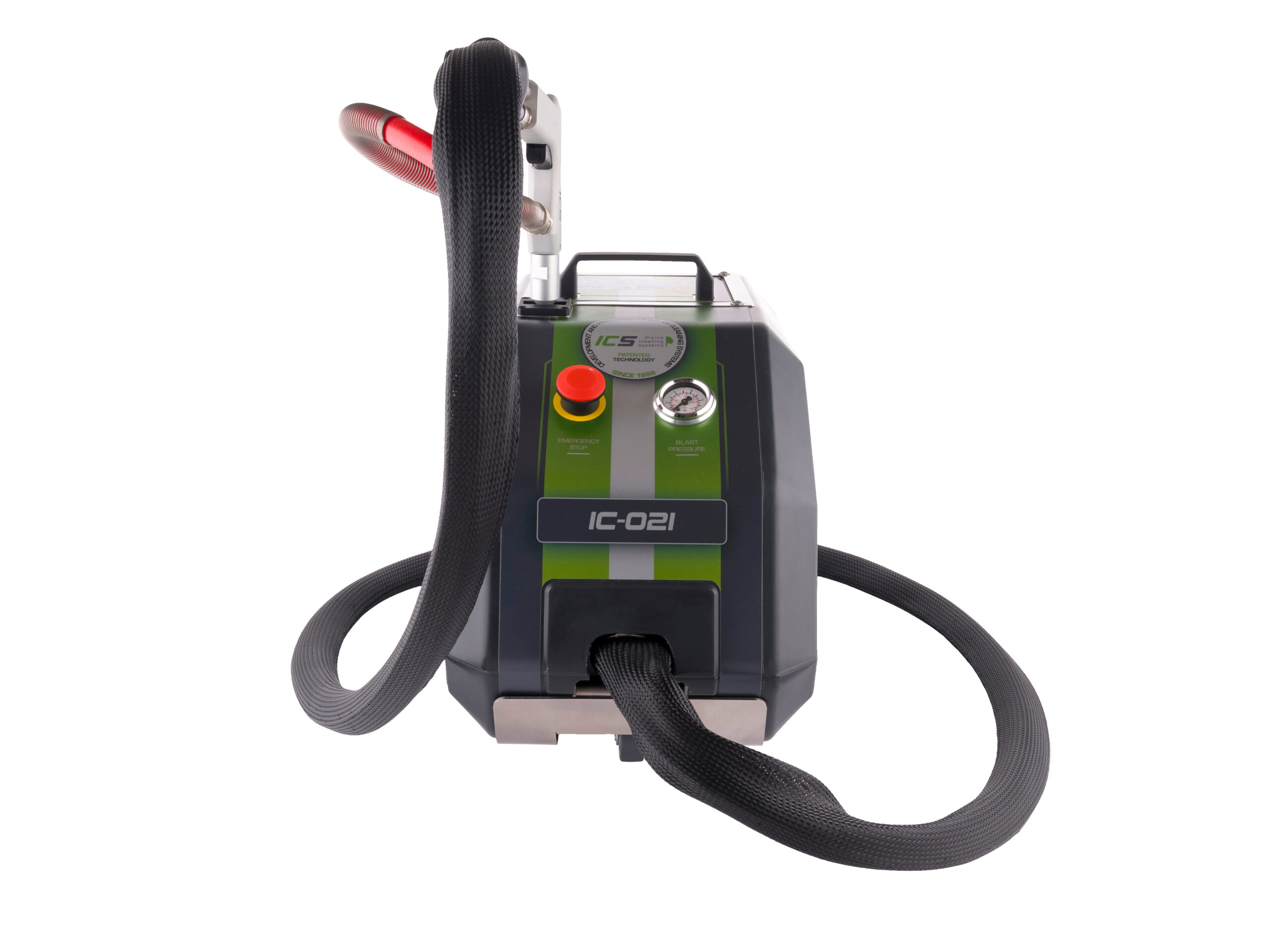
IC 021 ECO: lighter, repeat work
If you clean similar parts regularly and a round nozzle suits the job, the ECO is the first model we’d assess. At 17 kg with the hose, it’s also the lighter machine to move between work areas.
Explore the IC 021 ECO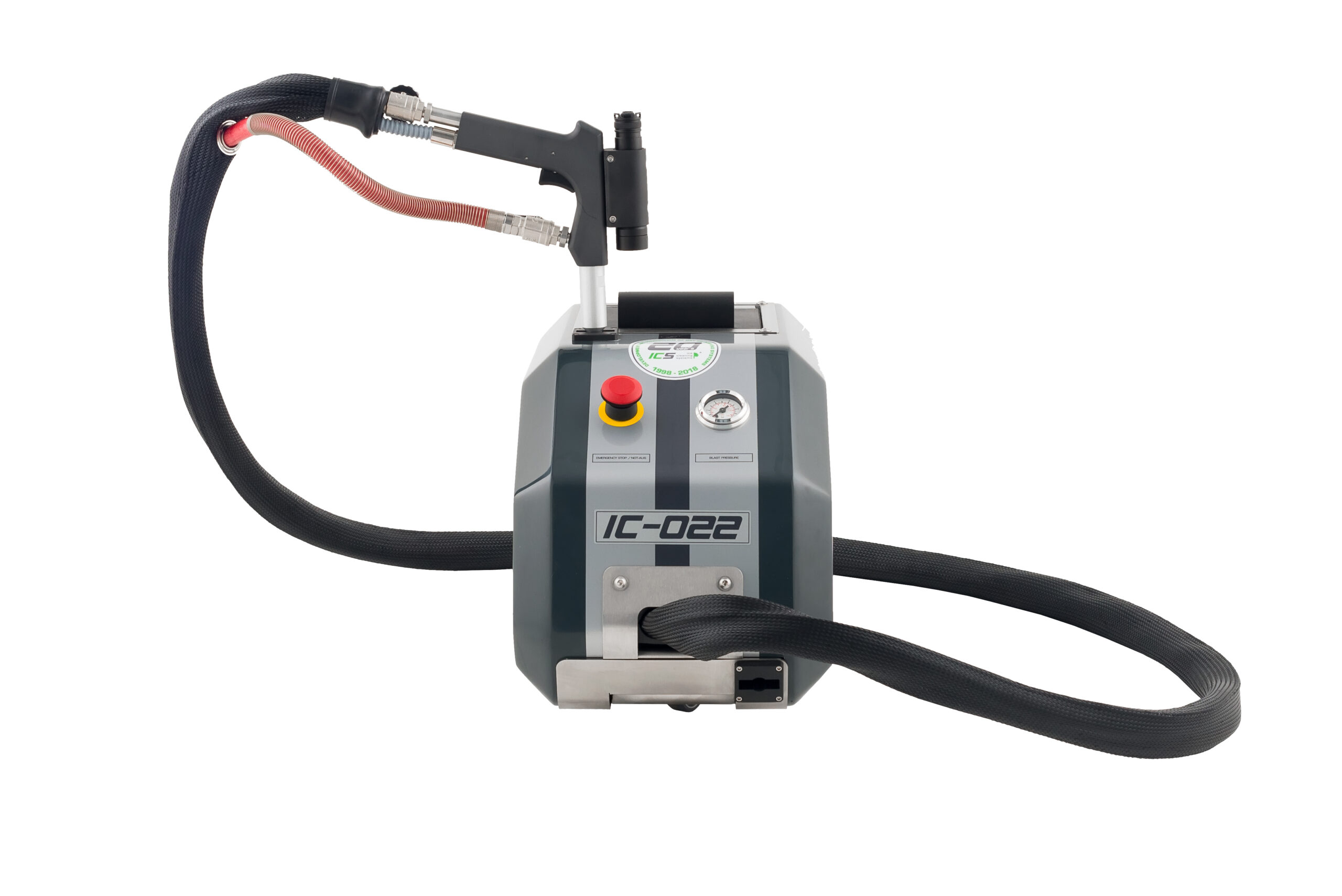
IC 022 EVO: more choice at the nozzle
If your work takes you from a narrow recess to a broader face, the EVO gives you round and flat nozzles as standard. Its 2–8 bar operating range gives you more scope to adjust the setup for different jobs.
Explore the IC 022 EVOWill your existing compressor run it?
Check the compressor’s free air delivery at the required pressure. A receiver marked “10 bar” tells you its pressure rating; it doesn’t tell you how much air the compressor can keep supplying once you pull the trigger.
The EVO’s airflow range overlaps the ECO’s at the low end, so choosing the EVO doesn’t automatically mean buying a larger compressor. Equally, a supply that covers the ECO’s 0.35 m³/min may fall well short of the 1.1 m³/min listed for the EVO at the upper end. Match the air supply to the nozzle you’ll actually use, allowing for other tools running on the same line.
What does the higher ice feed mean for costs?
The EVO can feed up to 25 kg of ice per hour against the ECO’s 18 kg. Those are maximum feed rates. They don’t tell you which machine cleans a particular component faster or uses less ice per finished job. To estimate running costs, use the time spent blasting and the amount of ice used on a representative part.
Get a recommendation and current UK pricing
Send us a photo of a typical part, tell us what you need to remove and how often you’ll clean it, and include your compressor model if you have one. We’ll help you decide whether the ECO or EVO suits the work and quote for the appropriate setup.
Titus Equipment is the UK certified service partner for ICS. We provide operator training after purchase and handle servicing, repairs, spare parts and ongoing technical support directly.
Discuss your application with Titus